
The Core Concept of Text Prediction
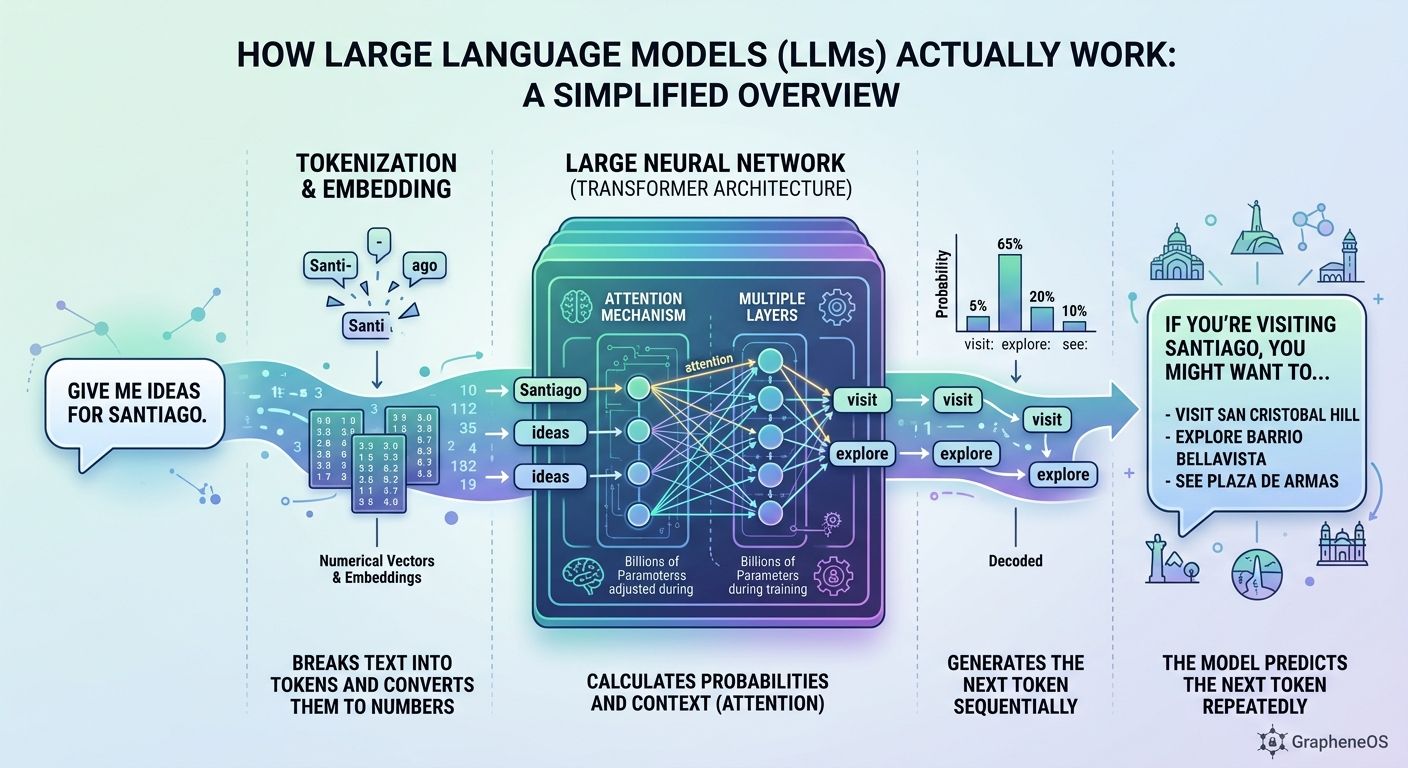
The easiest way to understand an LLM is to look at a simple example. Imagine asking an AI for advice on visiting Santiago. The model does not retrieve a pre-written answer from a static database. Instead, it processes the words in your prompt and generates a response sequentially.
It predicts which token is most likely to come next. Then, it uses that newly generated token as part of the context to predict the subsequent one. For example, after producing the phrase, "If you are visiting Santiago, you might want to," the model considers possible continuations. It assigns high mathematical probabilities to relevant words such as "visit," "explore," or "see." The model selects one and repeats this process until the response concludes.
To see this token generation in action, here is a standard API request and the model's sequential output:
$ curl https://api.openai.com/v1/completions \
  -H "Content-Type: application/json" \
  -H "Authorization: Bearer YOUR_API_KEY" \
  -d '{
    "model": "text-davinci-003",
    "prompt": "If you are visiting Santiago, you might want to",
    "max_tokens": 5
  }'

# Output:
# {"choices": [{"text": " explore the local historical sites"}]}
Turning Language Into Numbers
A computer cannot directly perform neural network calculations on raw text. Language must be converted into numerical representations. The text is broken down into smaller pieces called tokens. A token might represent an entire word, part of a word, or even just punctuation.
Each token is associated with a vector, which is essentially a long list of numbers. These vectors capture relationships between different pieces of language. Tokens that appear in similar contexts develop related numerical representations. Instead of memorizing dictionary definitions, the network learns statistical relationships from the enormous quantity of text it processes during training.
You can observe how text breaks down into numerical tokens using open-source libraries:
from transformers import AutoTokenizer
tokenizer = AutoTokenizer.from_pretrained("gpt2")
tokens = tokenizer.encode("Santiago is beautiful.")
print(tokens)

# Output:
# [34098, 2697, 318, 4950, 13]
The Neural Network and Attention
At the heart of a modern LLM is the Transformer architecture. A transformer contains many layers through which the numerical representation of your text passes. One of the most important mechanisms inside this architecture is called "attention."
Attention allows the model to consider relationships between different parts of the input. When processing a sentence containing a pronoun, the model uses information from other words to determine exactly which earlier nouns are relevant. When predicting the next token, not every previous token is equally important. The attention mechanism allows the network to assign different amounts of importance to various parts of the context.
This results in a complex mathematical transformation. You can read the original technical breakdown of this architecture in the Attention Is All You Need paper. If you want to understand the foundational mathematics of these networks, 3Blue1Brown's machine learning series provides excellent visual explanations. For a broader overview of AI progress, the Stanford AI Index is a great resource.
Why do Large Language Models make mistakes?
An LLM is fundamentally trained to generate likely text continuations. Therefore, a confident-sounding answer is not automatically a correct answer. The model can produce something that looks highly plausible because it fits the statistical patterns it learned, even when the factual information is entirely wrong.
This specific behavior is commonly referred to as an AI hallucination. Understanding this underlying mechanism explains why human verification remains critically important. When using language models for financial, medical, or technical information, you must verify the output. To learn more about securing these tools in a corporate environment, review our internal AI safety policies and our guide to machine learning basics. You can also explore Hugging Face's documentation on model limitations or OpenAI's safety guidelines for developers.
How do LLMs learn to converse?
Raw next-token prediction is not enough to create a useful assistant. A model trained only on arbitrary internet text might produce responses that are grammatically plausible but unhelpful, offensive, or repetitive.
To solve this, developers use additional training phases. Human feedback and carefully constructed examples help teach the model how to follow instructions and produce useful formatting. This supplementary process ensures the system behaves like a helpful chat assistant rather than just a random text generator. The result is a highly capable system that can summarize information, write software, and explain concepts simply through mathematical pattern matching.
If you are building your own tools using these models, security is paramount. Protect your infrastructure by scheduling our AI Security Check today to ensure your data remains completely private and secure.