
Penetration testing (pen testing) is a legal and authorized simulated cyber-attack on a computer system to evaluate its security.
Pen testers act like real hackers: they use the same tools, techniques, and thinking to find and show weaknesses that could hurt the business.
Pen testing can target many systems such as web apps, mobile apps, networks, cloud, IoT, containers, APIs, and CI/CD pipelines.
Since every system has different attack surfaces, there will be different testing steps, tools, and goals.
Testers may have different levels of system access:
- Opaque box – no internal info (like external hackers)
- Semi-opaque box – some credentials and system information
- Transparent box – full access to source code and systems
Pen testing can be manual (creative hacker testing) or automated (scanners and tools).
Manual testing finds deeper vulnerabilities and business-logic flaws, while automated testing is faster and repeatable.
Why Is Penetration Testing Needed
Pen testing is needed because systems are not always secure even if it’s designed to be safe.
It helps organizations to:
- Find weaknesses and vulnerabilities in systems.
- Check how strong their security controls really are.
- Support compliance (PCI DSS, HIPAA, GDPR, SOC 2, etc.
- Give the management team clear information about security risks and budget needs.
- Improve defenses like WAF (Web Application Firewall) by showing real attack results. .
The Pros of Hiring Pentesting Expert:
- Finds gaps missed by scanning tools and security standards.
- Detects known and unknown vulnerabilities.
- Simulates real hacker behavior realistically across any system.
The Cons of Hiring Pentesting Expert:
- Labor-intensive and expensive.
- Cannot guarantee all bugs are removed from production.
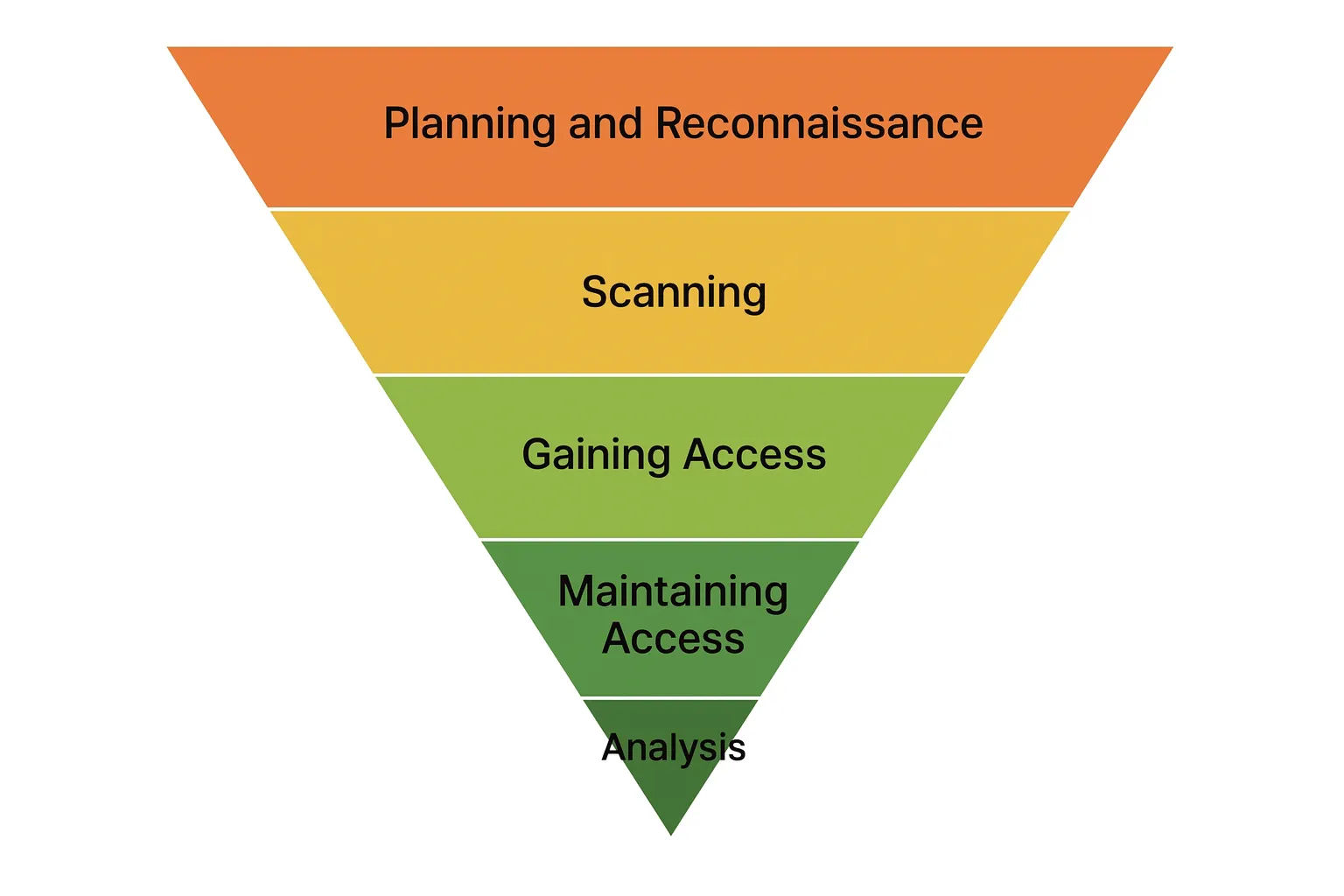
The Inverted Pyramid Hacking Process
Think of a cyber-attack (or a penetration test) like a funnel that starts wide and becomes more focused and deeper over time. At first, the attacker tries to learn as much as possible, and then gradually chooses the most valuable weakness to attack and exploit.
Here’s the step-by-step breakdown:
1. Planning & Reconnaissance (“Looking for clues from the outside”)
This is the most open and broad phase, and that’s why it sits at the top of the pyramid. The pen tester tries to collect everything possible about the target without touching the system too much.
Examples of what they do:
- Search the internet and social media for company information.
- Look up domain registrations, IP addresses, emails.
- Observe login pages, forgotten subdomains, API endpoints.
- Use light-touch network scanning to map the attack surface.
- Social engineering or dumpster diving (yes, literally checking the trash).
The purpose is to understand how the system is built and where the weak spots might be.
2. Scanning (“Knocking on the doors to see which ones open”)
Now the tester uses tools to interact more directly with the system and identify weaknesses.
Two main scanning types:
- Static analysis. Pentester scans the system code (if available) to predict vulnerabilities.
- Dynamic analysis. Pentester tests the app while running to see how it reacts to inputs.
Examples of what scanning can reveal:
- Open ports and services that shouldn’t be exposed.
- Weak authentication or session handling.
- Vulnerable libraries or outdated software.
- API endpoints that leak too much data.
The goal here is to map which weaknesses are worth attacking.
3. Gaining Access (“Breaking in using the best weakness found”)
Now the pyramid narrows. The pen tester launches real attacks based on everything discovered earlier.
These attacks can include:
- SQL Injection.
- Cross-Site Scripting (XSS).
- Exploiting weak passwords.
- Tricking employees through phishing.
- Dropping malware or backdoors.
Once inside, the pen tester will try to Escalate their privileges, move deeper inside the network, and gain access to sensitive data.
4. Maintaining Access (“Staying inside without being kicked out”)
Here the pen tester tries to:
- Hide inside the system.
- Bypass security monitoring.
- Create persistent access (like a backdoor).
- Continue collecting or modifying data.
This stage imitates advanced persistent threats (APTs), real attackers that quietly stay inside networks for months. The purpose is to show the possible long-term damage if the system is not fixed.
5. Analysis & Reporting (“Explaining what happened and how to fix it”)
Finally, the tester stops the attack and summarizes everything clearly.
A good report includes:
- Which vulnerabilities were exploited.
- How access was gained.
- What sensitive data was accessed.
- How long the tester stayed undetected.
- The real business impact.
- Step-by-step recommendations to fix the weaknesses.
The final goal is to to make the organization stronger and safer against real attackers.