


AI-Generated Malware Campaign Scales Threats Through Vibe Coding Techniques
Threat actors are increasingly leveraging Large Language Models (LLMs) and "vibe coding"—generating functional software from natural language prompts—to automate, scale, and accelerate malicious operations. A recent large-scale threat campaign illustrates how AI-driven development allows attackers with minimal programming expertise to deploy sophisticated, multi-stage infection chains at rapid speed.
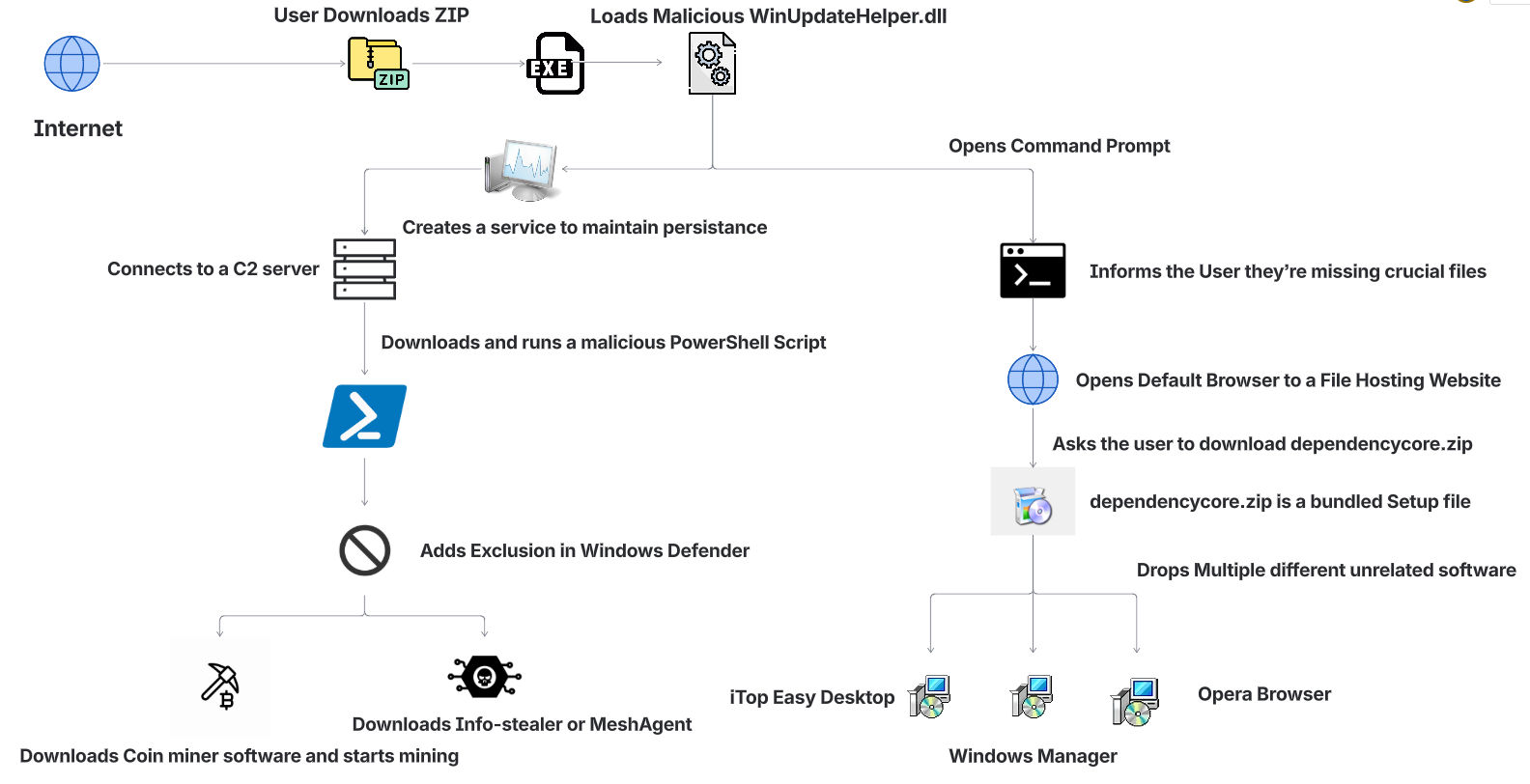
Threat actors are increasingly turning to Large Language Models (LLMs) and "vibe coding"—the practice of generating functional code through simple, iterative natural language prompts—to automate and scale malicious operations. A recent large-scale threat campaign illustrates how AI-driven development lowers technical barriers while drastically accelerating malware development cycles. By offloading complex code construction to generative AI, attackers can rapidly produce diverse payloads, adjust execution paths, and launch sophisticated operations with minimal programming expertise.
Massive Distribution Network via App Impersonation
The campaign encompasses more than 440 malicious ZIP archives hosted across popular file-sharing platforms, developer repositories like SourceForge, and community hubs like Discord. To maximize infection rates, attackers rely on targeted social engineering, disguising their malicious archives as high-demand utility software.
Infected archives routinely impersonate:
Popular video game modifications and cheats
AI software tools and productivity utilities
Cryptocurrency trading bots and financial utilities
Commercial VPN clients and system hardware drivers
Users seeking free software, cracked utilities, or community tools unknowingly download and execute these trojanized payloads, initiating an automated compromise sequence on their local endpoints.
Multi-Stage Infection Chain Analysis
The infection workflow combines classical DLL side-loading with multi-stage PowerShell execution to evade basic security controls:
| Stage | Technical Behavior |
| Initial Execution | User launches a trojanized application, which side-loads a malicious loader (WinUpdateHelper.dll). |
| Decoy Action | To reduce suspicion, the loader installs benign decoy software while silently connecting to C2 infrastructure. |
| Social Engineering | The user is prompted to download required "system dependencies" to continue using the software. |
| Payload Delivery | Obfuscated PowerShell scripts retrieve and execute secondary payloads directly in memory. |
| Final Stage | Deployment of XMRig cryptocurrency miners or credential stealers targeting sensitive user data. |
AI Code Generation & Modular Architecture
A key technical indicator identified during analysis is the presence of structured, human-like inline comments embedded within the delivery scripts. These comments systematically describe step-by-step file creation, execution paths, registry adjustments, and network request routines—a distinct hallmark of output produced by conversational LLM prompts.
Across the campaign, threat researchers cataloged 48 unique DLL variants grouped into 17 distinct kill chains. While network infrastructure and distribution channels vary between campaign branches, the underlying functional logic remains consistent. This modular code reuse demonstrates how threat actors leverage automated LLM workflows to quickly modify signatures and generate code variations at scale.
Evasion Mechanisms and Final Payloads
To counter security analysis, the PowerShell delivery phase incorporates aggressive anti-analysis and evasion controls:
Time-Sensitive Delivery: Download URLs generated for secondary payloads are unique to each victim and expire within seconds.
Context Restriction: Payload delivery is restricted exclusively to valid, active PowerShell execution environments.
Scanner Filtering: Built-in user-agent inspection filters out automated threat scanners, sandboxes, and security tools.
The final payloads consist primarily of XMRig cryptocurrency miners and sophisticated infostealers designed to harvest browser cookies, saved passwords, crypto wallet details, and system metadata.
Financial and Operational Impact
The operation has impacted organizations and individual users globally, with significant activity detected in the United States, United Kingdom, India, and Brazil. Tracked cryptocurrency wallets associated with the operation confirm earnings exceeding $4,500, though total profits are estimated to be substantially higher due to the use of privacy-focused coins like Monero.
As generative AI tools become more integrated into software development workflows, defense teams must prepare for high-volume, AI-assisted threat campaigns designed to bypass traditional signature-based detection mechanisms.