
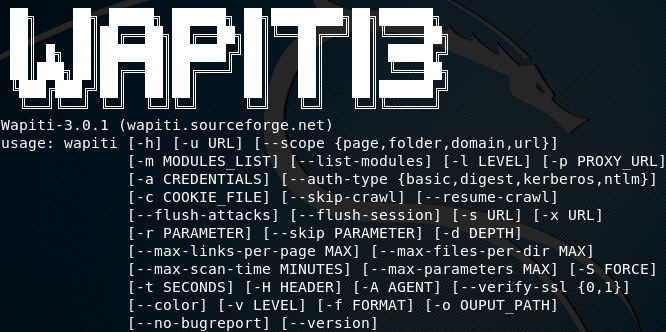
Wapiti
Wapiti allows you to audit the security of your websites or web applications.
It performs "black-box" scans (it does not study the source code) of the web application by crawling the webpages of the deployed webapp, looking for scripts and forms where it can inject data.
Once it gets the list of URLs, forms and their inputs, Wapiti acts like a fuzzer, injecting payloads to see if a script is vulnerable.
What's new in Wapiti 3.3.1 ? Take a look here.
Wapiti modules cover:
SQL Injections (Error based, boolean based, time based) and XPath Injections
LDAP injections (Error based and boolean based)
Cross Site Scripting (XSS) reflected and permanent
File disclosure detection (local and remote include, require, fopen, readfile...)
Command Execution detection (eval(), system(), passtru()...)
XXE (Xml eXternal Entity) injection
CRLF Injection
Search for potentially dangerous files on the server (thanks to the Nikto db)
Bypass of weak htaccess configurations
Search for copies (backup) of scripts on the server
Shellshock
Folder and file enumeration (DirBuster like)
Server Side Request Forgery (through use of an external Wapiti website)
Open Redirects
Detection of uncommon HTTP methods (like PUT)
Basic CSP Evaluator
Brute Force login form (using a dictionary list)
Checking HTTP security headers
Checking cookie security flags (secure and httponly flags)
Cross Site Request Forgery (CSRF) basic detection
Fingerprinting of web applications using the Wappalyzer database, gives related CVE information
Enumeration of popular CMS (Drupal, Joomla, Magento, Prestashop, SPIP, Typo3, Wordpress, etc)
Detection of subdomain takeovers vulnerabilities
Log4Shell vulnerability detection (CVE-2021-44228)
Spring4Shell (CVE-2022-22965) detection
Check https redirections
Check for file upload vulnerabilities
Detection of network devices
Inject payloads inside JSON body too
Check for TLS misconfiguration and vulnerabilities (thanks to sslscan)
Wapiti supports both GET and POST HTTP methods for attacks.
It also supports multipart forms and can inject payloads in filenames (upload).
Warnings are raised when an anomaly is found (for example 500 errors and timeouts)
Wapiti is able to make the difference between permanent and reflected XSS vulnerabilities.
General features :
Generates vulnerability reports in various formats (HTML, XML, JSON, TXT, CSV, Markdown)
Can suspend and resume a scan or an attack (session mechanism using sqlite3 databases)
Can give you colors in the terminal to highlight vulnerabilities
Different levels of verbosity
Fast and easy way to activate/deactivate attack modules
Adding a payload can be as easy as adding a line to a text file
Configurable number of concurrent tasks to perform HTTP requests
Browsing features
Support HTTP, HTTPS and SOCKS5 proxies
HTTP authentication on the target (Basic, Digest, NTLM)
Authentication by filling login forms
Ability to restrain the scope of the scan (domain, folder, page, url)
Automatic removal of one or more parameters in URLs
Multiple safeguards against scan endless-loops (for example, limit of values for a parameter)
Possibility to set the first URLs to explore (even if not in scope)
Can exclude some URLs of the scan and attacks (eg: logout URL)
Import cookies from your Chrome or Firefox browser or using the wapiti-getcookie tool
Can activate / deactivate SSL certificates verification
Try to extract URLs from javascript (very basic JS interpreter)
HTML5 aware (understand recent HTML tags)
Several options to control the crawler behavior and limits.
Skipping some parameter names during attack.
Setting a maximum time for the scan process.
Adding some custom HTTP headers or setting a custom User-Agent.
Man-In-The-Middle proxy support to explore the target by using your browser
Automated browsing using Firefox in headless mode
Loading your own python code for complicated authentication cases (see --form-script option)
Adding custom URL or PATH to update Wappalyzer database
Scan REST APIs given an OpenAPI (swagger) file
Wapiti is a command-line application.
Here is an example of output against a vulnerable web application.
You may find some useful information in the README and the INSTALL files.
Have any questions ? You may find answers in the FAQ.
