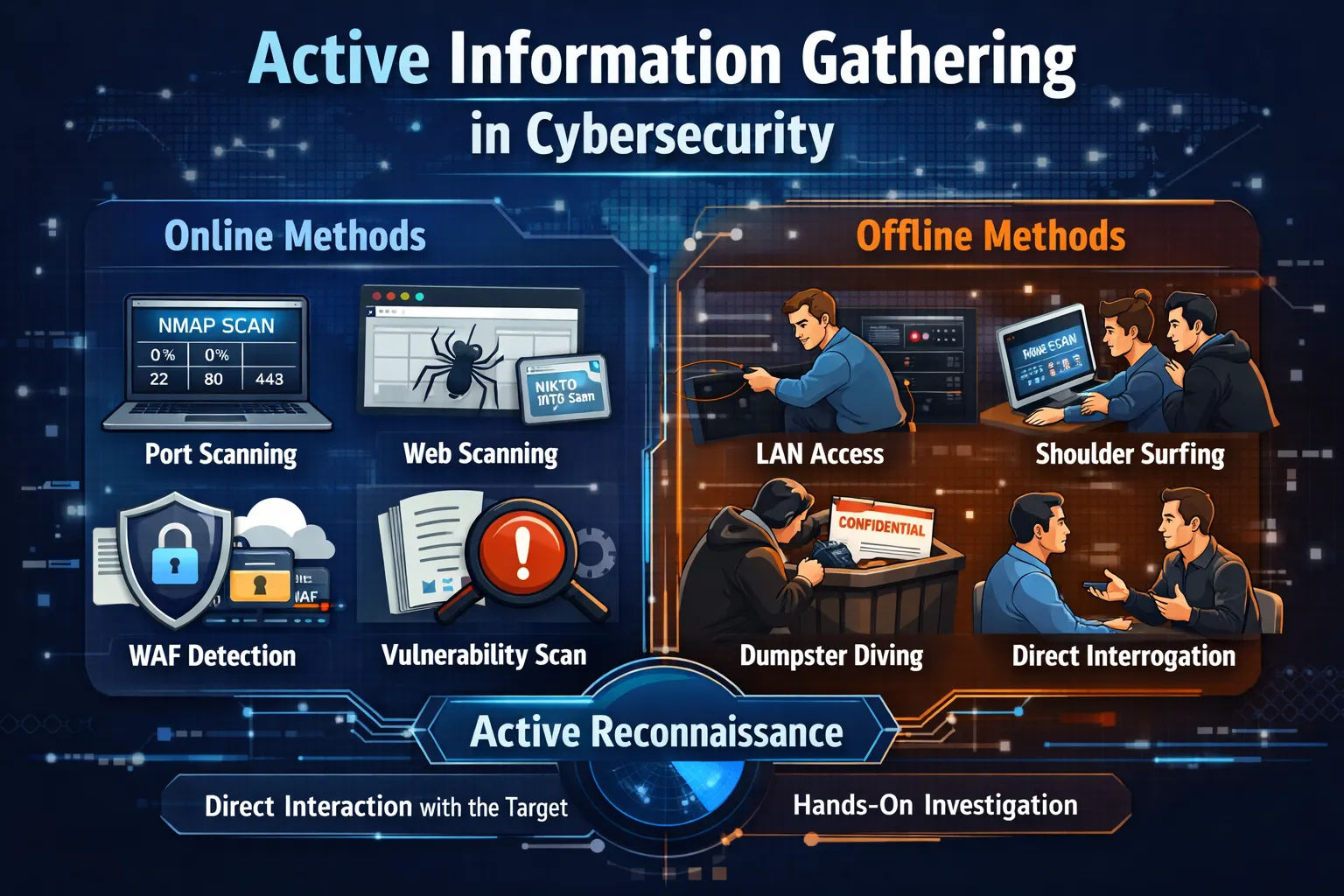

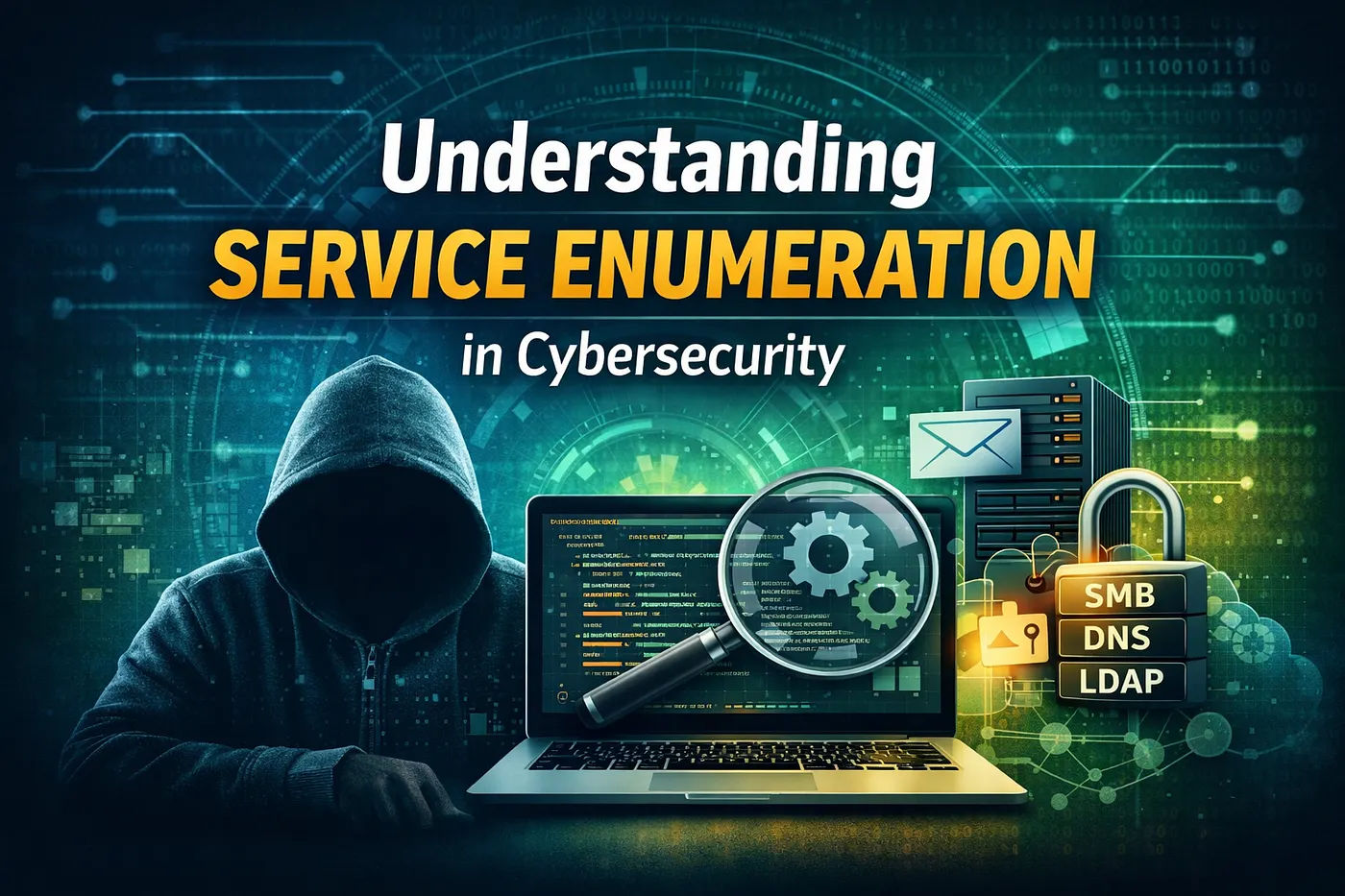
The main purpose of service enumeration is to collect detailed information about services running on a target system so that security weaknesses can be identified and evaluated.
Understanding Service Enumeration in Cybersecurity: Concepts, Tools, and Methodologies
In penetration testing and ethical hacking, reconnaissance moves through structured phases to map an enterprise attack surface. Once initial network scanning identifies active hosts and open network ports, security auditors transition to Service Enumeration. While basic port scanning merely reveals whether a network port is open or closed, service enumeration establishes active communication channels to extract deep, operational intelligence from the underlying applications.
What Is Service Enumeration?
Service enumeration is the process of actively querying running services on a target system to extract technical metadata, configurations, and user details. By interacting directly with open application sockets, penetration testers uncover actionable intelligence that reveals how a service behaves and what security vulnerabilities it introduces.
Key Information Extracted During Enumeration:
Exact service software types and build version numbers
Active usernames, system accounts, and group memberships
Shared network resources, SMB shares, and directory trees
Operating system versions, system hostnames, and domain structures
Application banners, banner Grab information, and configuration flags
Scanning vs. Service Enumeration: The Technical Distinction
Understanding the difference between port scanning and service enumeration is crucial for security analysts:
| Phase | Operational Focus | Typical Data Obtained |
| Port Scanning | Surface discovery across network IP ranges. Identifies live hosts and listening port numbers. | Open ports (e.g., Port 22, Port 80, Port 443, Port 445). |
| Service Enumeration | Deep inspection through active connection sockets. Interrogates running applications directly. | Software build versions (e.g., OpenSSH 8.2p1), SMB shares, valid usernames, system configurations. |
Port scanning identifies where potential entry points exist; service enumeration opens those doors to evaluate system posture and detect exploitable vulnerabilities.
Core Protocols and Service Enumeration Vectors
Different network services expose unique administrative interfaces and protocol commands that analysts exploit during testing:
1. SMB / NetBIOS Enumeration (Ports 139 / 445)
Common in Windows and Linux Samba environments, Server Message Block (SMB) enumeration allows testers to list unauthenticated network shares, query domain user accounts, retrieve password policies, and enumerate system group memberships.
2. SNMP Enumeration (Ports 161 / 162)
The Simple Network Management Protocol (SNMP) monitors network infrastructure devices. If configured with default community strings (such as public or private), SNMP reveals routing tables, ARP caches, installed software packages, and system device descriptions.
3. SMTP Enumeration (Port 25)
Simple Mail Transfer Protocol servers often support built-in diagnostic commands like VRFY (verify user), EXPN (expand mailing list), and RCPT TO. Testers utilize these commands to validate legitimate internal email addresses for subsequent security assessments.
4. LDAP Enumeration (Port 389)
Lightweight Directory Access Protocol (LDAP) integrates organizational user accounts and Active Directory environments. Unauthenticated LDAP queries allow security auditors to extract complete organizational hierarchies, active directory trees, and corporate username lists.
Industry-Standard Service Enumeration Tools
Security professionals leverage specialized command-line utilities within Linux distributions like Kali Linux to automate service interrogation:
Nmap (NSE Scripts): Uses the Nmap Scripting Engine (
-sC,-sV) to banner grab and automatically execute service-specific enumeration scripts.Enum4linux / Enum4linux-ng: Specialized tools designed specifically for enumerating Windows host data, SMB shares, and domain details from Samba services.
SNMPwalk: Sends automated
GetNextRequestqueries to extract complete Object Identifier (OID) trees from vulnerable SNMP daemons.
Conclusion and Mitigation Strategies
Service enumeration bridges the gap between initial host discovery and targeted vulnerability exploitation. To mitigate enumeration risks, security teams must enforce the principle of least privilege, disable unnecessary network protocols, restrict default SNMP community strings, implement strict firewall controls, and disable detailed application banner responses across production servers.