
Active Information Gathering in Cybersecurity: Fundamentals, Tools, and Execution Methods
In ethical hacking, penetration testing, and red teaming operations, reconnaissance is the foundational phase that determines the trajectory of an entire security assessment. While passive information gathering relies on harvesting publicly accessible data without directly contacting the target, Active Information Gathering involves direct, hands-on interaction with target infrastructure to extract granular technical intelligence.
Understanding Active Information Gathering
Active information gathering is a technical reconnaissance methodology where security auditors send network packets, service probes, and specialized HTTP/HTTPS requests directly to live target assets. Because these probing activities generate real network traffic, the target's perimeter defenses—including network firewalls, Intrusion Detection Systems (IDS), Intrusion Prevention Systems (IPS), and Web Application Firewalls (WAF)—can detect the traffic and log the source IP address.
Ethical hackers typically execute active reconnaissance after passive OSINT (Open Source Intelligence) collection has established initial target boundaries, such as public IP blocks and registered domain assets.
Core Operational Characteristics:
Direct Interaction: The tester establishes active network sockets and socket connections with the target system.
High Visibility: Requests leave distinct footprints across web server logs, firewall rule triggers, and SIEM monitoring dashboards.
Granular Intelligence: Delivers precise technical data regarding open ports, active services, software versions, and configuration flaws.
Strict Legal Requirements: Must only be conducted under an authorized Scope of Work (SOW) and explicit Rules of Engagement (ROE).
Core Tools for Active Information Gathering
Penetration testers depend on specialized command-line tools in Linux distributions like Kali Linux to systematically inspect target hosts and web services:
1. Nmap (Network Mapper)
Nmap is the premier open-source tool for network discovery, port scanning, and service identification.
Service Version Detection:
Bashsudo nmap -sV -p 21,22,25,53,80,443,3389 target_ip(Scans critical administrative and web ports like FTP, SSH, SMTP, DNS, HTTP, HTTPS, and RDP).
Vulnerability Scripting Engine (NSE):
Bashsudo nmap --script vuln target_ipAggressive Fingerprinting:
Bashsudo nmap -A target_ip(Combines operating system detection, service versioning, script execution, and network traceroute).
2. wafw00f (Web Application Firewall Detection)
Before conducting web security tests, auditors must evaluate whether a site is protected by a reverse proxy or cloud WAF solution:
wafw00f https://target_domain.com
Detecting solutions like Cloudflare, AWS WAF, or ModSecurity allows testers to calibrate scan speeds and request headers to prevent immediate IP bans or automated rate-limiting.
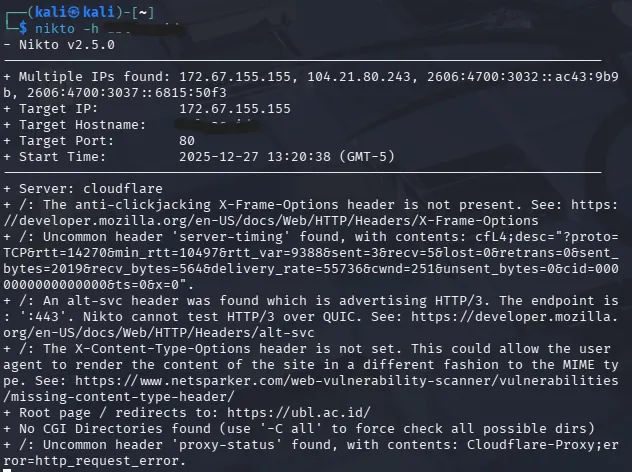
3. Nikto (Web Server Scanner)
Nikto is an open-source web server scanner that tests for thousands of known vulnerabilities, dangerous files, and misconfigurations:
nikto -h https://target_domain.com
Nikto inspects server banners, identifies hidden directories, checks HTTP security headers, and reports outdated server daemons across Apache, Nginx, and IIS deployments.
Active Reconnaissance Methodologies
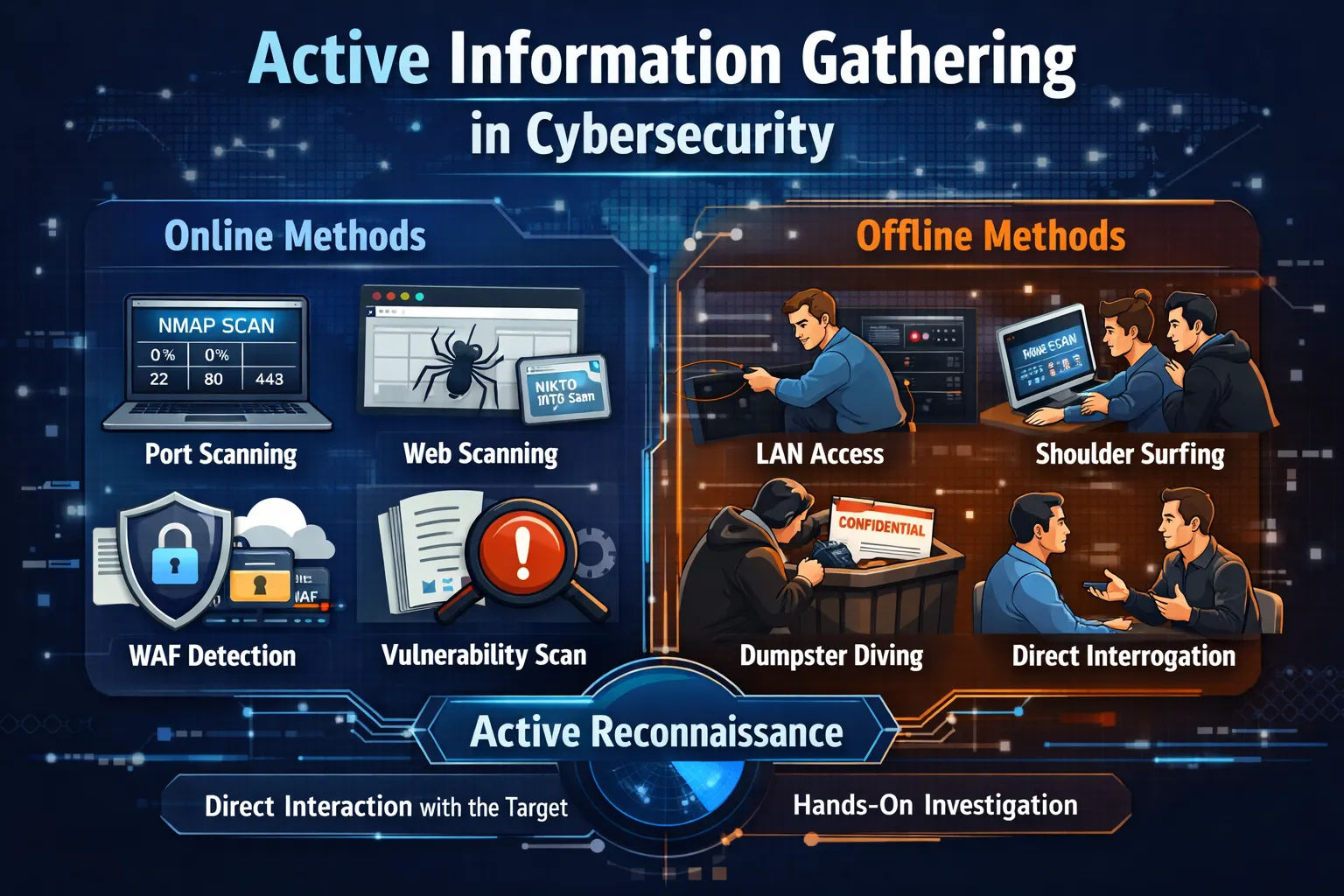
Active information gathering methodologies generally fall into two primary operational categories:
Online Active Reconnaissance
Online methods occur remotely across public internet connections or internal subnets. Analysts send targeted network packets to establish connections with live IP addresses, map listening ports, enumerate running web application parameters, and test perimeter defenses.
Offline and On-Premise Reconnaissance
Offline methods require physical proximity or physical access to target facilities. This includes plugging directly into internal network drops, executing local Ethernet and Wi-Fi packet captures, analyzing discarded physical technical documents, or directly interacting with internal staff through physical social engineering techniques.
Conclusion
Active information gathering provides the critical technical foundation required to construct accurate threat models and identify exploitable entry points. However, because it generates noisy network footprints, ethical security professionals must combine active scanning techniques with careful rate control and strict compliance with legal testing boundaries.